Estimation · uncertainty propagation
When one Gaussian is not enough: orbit uncertainty after a tracking gap
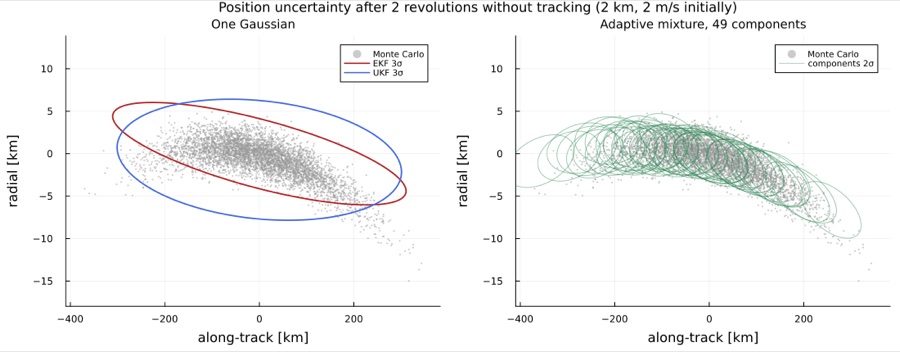
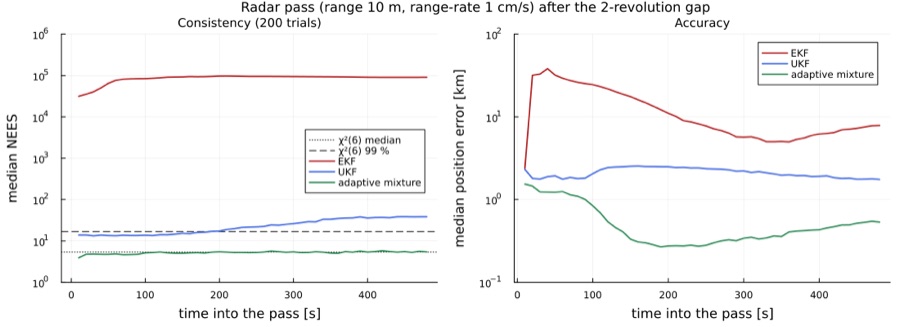
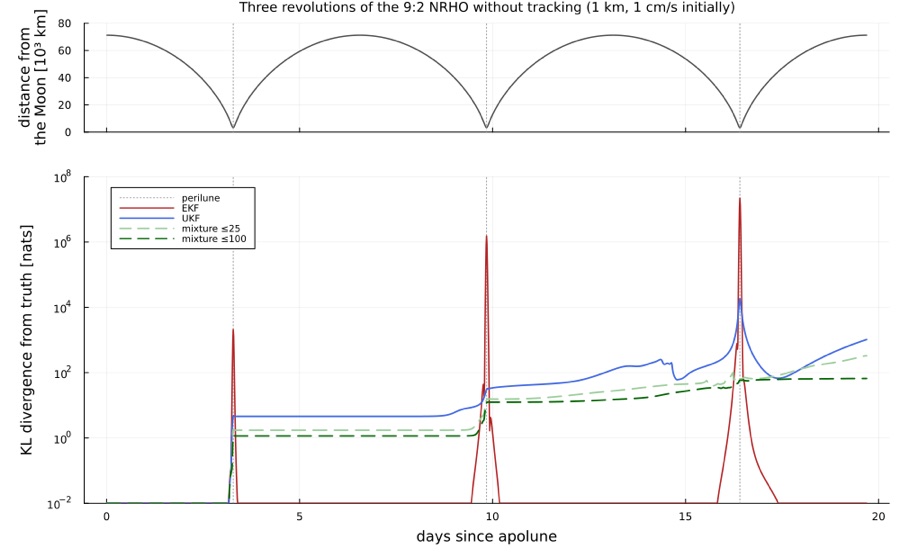
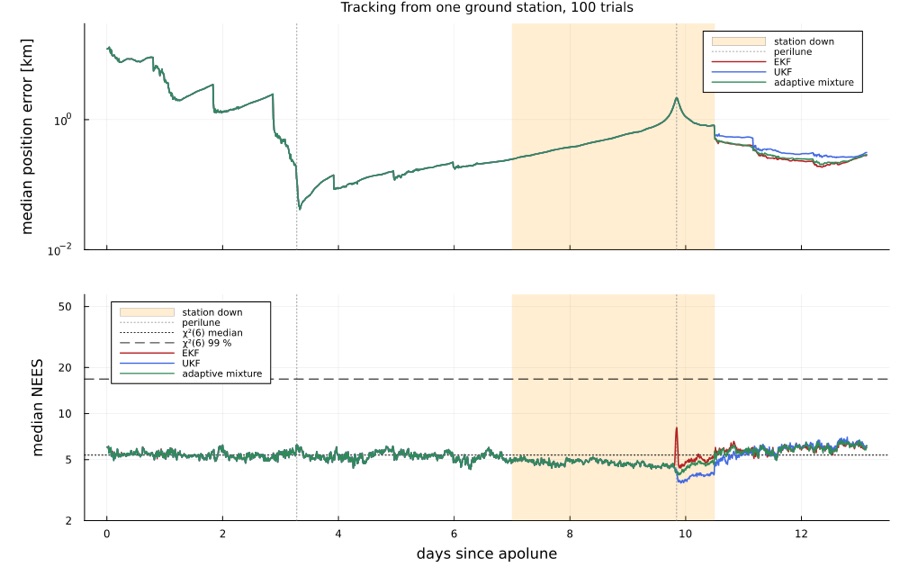
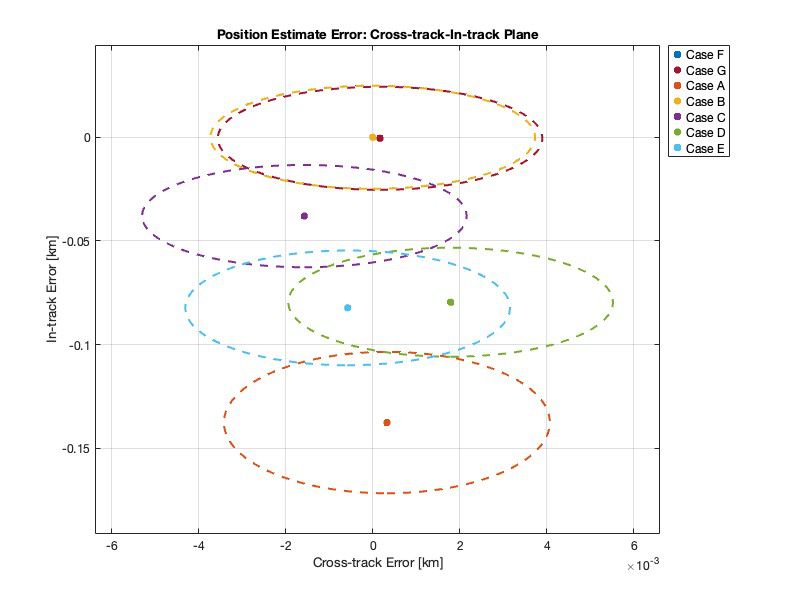
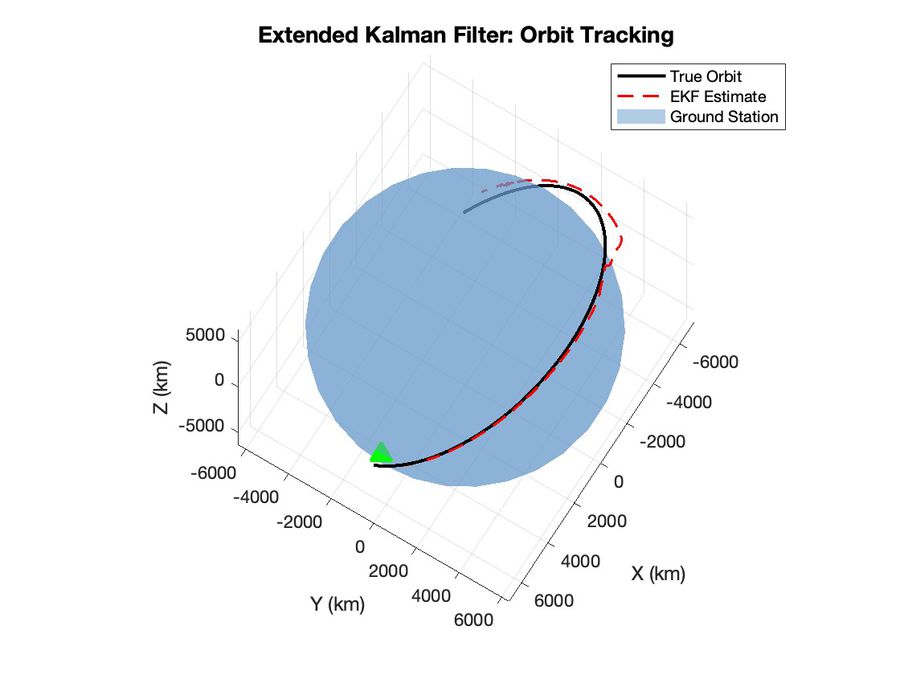
Added an adaptive Gaussian mixture filter to my Julia estimation toolkit. It starts from a single Gaussian and splits a component in three when the dynamics become too nonlinear across it (an entropy criterion after DeMars, Bishop & Jah), keeping the mean and covariance of the mixture exactly. I tested it on a 700 km satellite left untracked for two revolutions (3-D, two-body + J2), scoring each filter against 20,000 Monte Carlo samples, then through a radar pass in 200 trials. Writing the tests also exposed a Gaussian sum filter that had never worked and a likelihood underflow in nine particle and mixture filters; both are fixed.
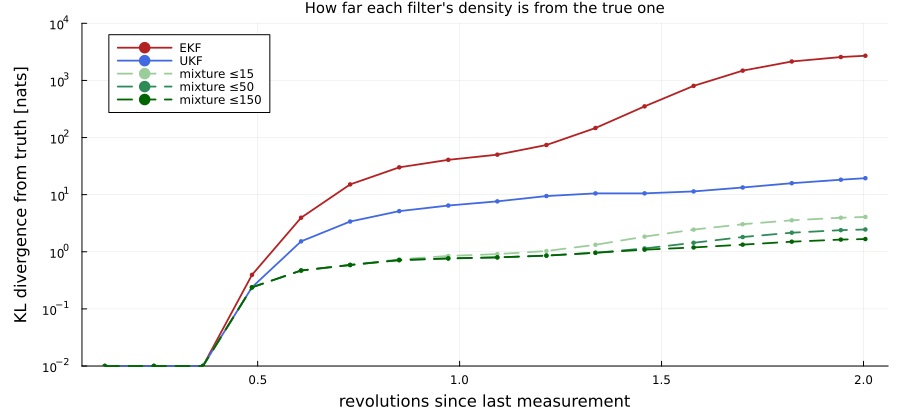
Outcome: after the gap the KL divergence from the true distribution is 2,700 nats for the EKF, 19 for the UKF and 2.5 for the mixture. Through the pass the mixture stays consistent (92–97% of trials inside the 99% bound, against 8% for the EKF and 34–63% for the UKF) and is 3 to 9 times more accurate than the UKF. Code →